
Free job posting
Post a Job for Free in India — Reach Seekers on JobBucket Apps
Free job posting on JobBucket means you create a vacancy once, publish it to the job portal and Android / iOS apps, and collect every application in your ATS — without buying a separate job board slot. Start free, no credit card. Upgrade only when you need more seats, AI screening, or assessments.
- Start free — no credit card
- Portal + Android & iOS apps
- Applications land in your ATS
Why it's free to start
Post the role. Reach seekers. Track applicants in one place.
JobBucket makes money on employer ATS plans — not by charging a listing fee every time you open a role. The first job you publish should prove the loop works.
No board-slot fee to start
Create your workspace and publish a structured vacancy without paying a per-post fee or handing over a card.
Same reach as any JobBucket listing
Free-to-start posts appear on the JobBucket portal and mobile apps — not a hidden “starter” feed.
Pipeline from day one
Every apply becomes a candidate record with stage history. You are not exporting CSVs from a board into a spreadsheet.
AI job description assist
Generate or tighten the JD and short description so the post is clear before seekers see it.
Screening questions on the vacancy
Ask must-haves up front so the first shortlist is cleaner than an open inbox.
Upgrade when the team grows
Plans from ₹1,499/mo add seats, AI screening, talent-database import, and assessments. Posting is not a surprise add-on.
How it works
Post a job free in four steps
- 01
Create a free employer workspace
Sign up in minutes. No credit card. You get a vacancy form, not a sales deck.
- 02
Describe the role once
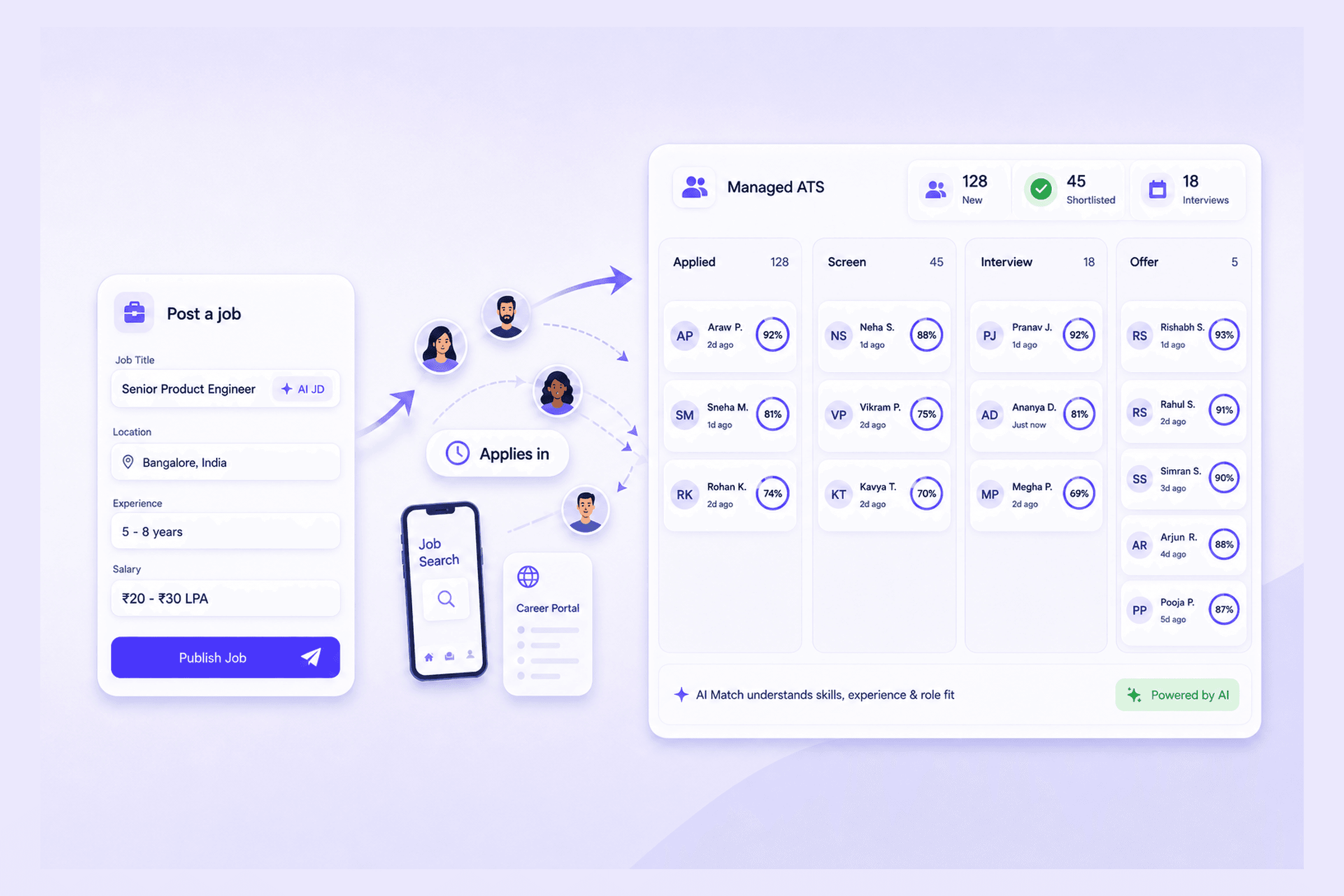
Add title, skills, locations, salary band, experience, and screening questions. Use AI assist if the JD is still a draft.
- 03
Publish to JobBucket seekers
One publish sends the opening to the portal and apps. Candidates apply with profile and resume.
- 04
Screen in the ATS
Applications land on the same pipeline — Applied through Interview and Offer — so hiring managers see one board.
What does free job posting actually include?
A free-to-start post is a real JobBucket vacancy: searchable on the portal, visible in the Android and iOS apps, and wired to your applicant pipeline. You get AI-assisted job copy, screening questions, and a candidate record for every apply. Paid plans unlock higher limits and deeper hiring tools — they do not “turn on” visibility that was hidden on the free start.
Why “free job posting” is usually a listing fee in disguise
Most job boards sell visibility. You pay to occupy a slot, then you pay again to feature it, then you export applicants into email. That model makes sense if the board is the only place candidates look. It is a poor fit if you already need an applicant tracking system to keep hiring managers aligned.
JobBucket is a job portal plus an ATS. The listing is how seekers find you. The pipeline is how you hire. Free job posting, here, means you can start that loop without buying a third-party board package first. You still decide later whether Freelancer, Starter, Growth, or Scale matches your volume.
Who should post a job for free on JobBucket
Founders filling the first few roles, in-house recruiters who are tired of retyping the same JD on three sites, and agencies that want client vacancies on a branded portal all get value from a single publish. If you hire two people a year through referrals only, you may not need a portal listing yet — post when you actually want inbound applicants.
Seekers browse and apply free on the apps. Employers start free, then pay for the operating system around the listing: screening, talent database, interviews, and seats. That split is intentional. Candidates should never pay to apply. Hiring teams should pay for workflow, not for the privilege of writing a job ad.
How a JobBucket vacancy is different from a classified ad
A classified post is a paragraph and a mailbox. A JobBucket vacancy is structured: skills, locations, salary band, experience range, employment type, and knockout questions. That structure is what makes search work on the apps and what makes AI screening possible later. If you skip the fields, you get noisier applies — the same problem you have on any board.
When someone applies, the resume can be parsed into a profile. Notes and stage changes stay on that record. You can boost a listing later if organic reach is not enough — featured and sponsored options still feed the same pipeline, so you are not running a parallel ad campaign in another tool.
What free job posting will not do
Publishing a role does not invent applicants. If the pay, location, or brief is uncompetitive, a free listing will show you that faster than a paid one — it will not rewrite the offer. An ATS organizes inbound talent; sourcing, employer brand, and compensation still sit with you.
Free start is also not “unlimited enterprise seats forever.” If five coordinators need the same pipeline, you will want a paid plan. That is a team problem, not a posting-fee problem. Compare billing on the pricing page before you assume the homepage number is month-eighteen cost.
Keep going from here
- Employer ATSPipelines, notes, and collaboration after someone applies.
- ATS overviewHow applicant tracking works from requisition to hire.
- PricingFreelancer to Scale — what you pay as hiring grows.
- Find jobsSee the board your listing will appear on.
- For employersHow hiring teams use JobBucket end to end.
- Job advertisementBoost a vacancy when organic reach is not enough.
FAQ
Free job posting — FAQs
Straight answers on posting a vacancy for free, where seekers see it, and when plans start.
Post your next role without buying a board slot first
Start free, publish to JobBucket seekers, and track applies in the ATS — or book a walkthrough on a live vacancy.