
How does an applicant tracking system actually work?
Under the interface, an ATS is a database with a workflow around it. Everything starts with a requisition: this role is open, this is the brief, this is who owns the hire. The job description is written once from that record and published outward — your careers presence, the JobBucket portal, mobile apps, or a boosted listing. Because the posting stays tied to the vacancy, every application returns already attached to the right role, with its source recorded.
When someone applies, the file is parsed. Unstructured resume text becomes structured fields: employers, dates, titles, skills. That is the step that removes retyping, and the reason a clean single-column resume parses more reliably than a two-column PDF built from text boxes. Screening then works on two levels. Knockout rules handle the absolutes — location, work authorization, minimum experience. Scoring ranks the rest by role fit. A recruiter still decides; ranking only changes what they read first. An explainable score you can override is more useful than a black-box number.
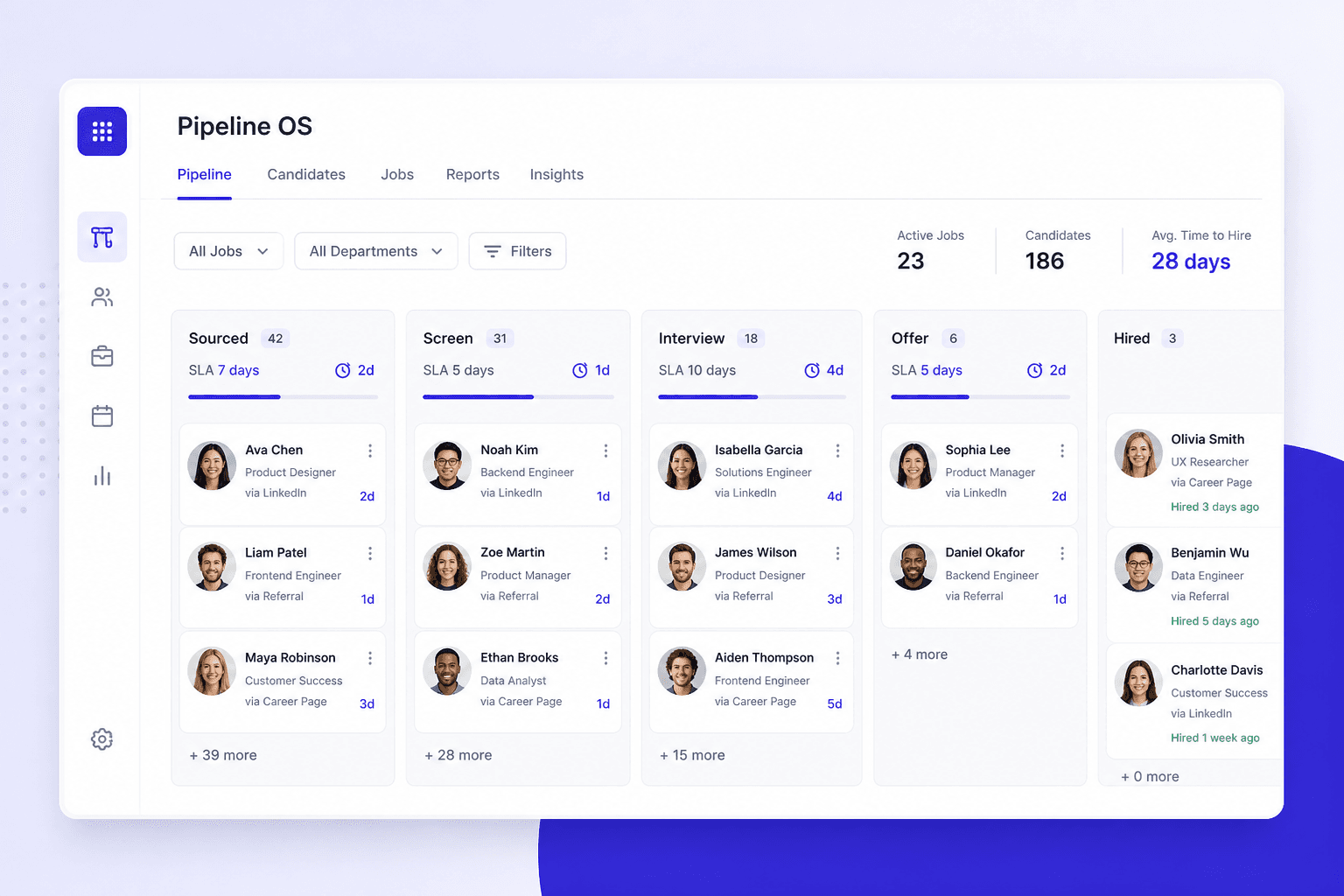
Candidates who move forward enter pipeline stages — applied, screened, interview, offer, hired — and every stage change is timestamped. The system then carries the practical work: interview scheduling, structured notes so a panel answers the same questions instead of trading impressions, and the offer itself. Reporting is the part most teams underestimate. Because each move was already stamped, time in stage, source of hire, offer acceptance, and the exact point candidates drop off fall out of work you did anyway.
Who needs an ATS — and who genuinely does not
Plenty of companies buy hiring software before they have a hiring problem. If you open two or three roles a year, one person reads every application, and a shared inbox with a folder per role has never lost anybody, an ATS will not make that hiring better. It adds an administrative layer to a process that already works at your scale. “Not yet” is a legitimate answer.
What tips the decision is rarely volume on its own. It is coordination. Two recruiters working five roles hit the wall sooner than one founder working ten, because the moment a second person needs the same candidate, an inbox stops being a system. The signals are specific: a hiring manager asks where a candidate went and nobody can answer; you post the same role in several places by hand; you want to re-approach someone you interviewed eight months ago and cannot find the notes. Any two together and tracking pays for itself.
Budget is a weak reason to wait. Jobscan’s 2025 ATS Usage Report puts Fortune 500 adoption at 97.8%. At the other end of the market, modern ATS software is priced for small teams rather than enterprise procurement. JobBucket plans start at ₹1,499 per month so a solo recruiter can run a real pipeline without a six-figure contract. The question is readiness, not whether software exists at your price.
Worth adopting when
More than one person reviews candidates, hiring is continuous rather than occasional, you publish each role in more than one place, or compliance and client reporting need an audit trail.
Probably not yet when
You hire two or three people a year, one person owns the process end to end, roles fill through referrals, and nobody else needs pipeline visibility. Revisit when one of those stops being true.
What changes in the first 90 days after you adopt one
The first fortnight is configuration, and the common mistake is redesigning your hiring process while you set the tool up. Mirror the stages you already use — awkward ones included. Import existing candidates, connect calendars, publish one live role. Change two things at once and you cannot tell which caused the problem.
Inside the first month the visible change is response time. Applications land in one queue instead of several inboxes. Templates remove the pause before every rejection or scheduling email. Candidates stop waiting a week for an answer that took thirty seconds to write. Hiring managers check a pipeline themselves instead of asking. Nobody registers that as a feature; they register that the backlog stopped growing.
Between days 60 and 90 you get the thing you actually bought: evidence. A full recorded cycle shows where candidates drop off, which sources produce people who reach interview rather than merely apply, and how long each stage really takes. SHRM’s 2025 Benchmarking Report puts average cost per hire for nonexecutive roles at $5,475 and median time to fill at about 45 days — so a stage quietly holding candidates for two weeks is worth finding. Use those numbers as a scale check, not a target; your market and role mix will differ. One caveat still holds: reporting is only as accurate as your stage discipline.
What an ATS does not solve
An ATS organizes applicants. It does not create them. If a role attracts four candidates a month, tracking those four more neatly will not fill it. That is a sourcing, pay, and employer-brand problem. The software shows you the low application rate faster than a spreadsheet would; it will not rewrite the ad. Job distribution and listing boosts can widen reach, but they still need a role people want.
It will not speed up a slow decision-maker either. When a hiring manager takes eleven days to review a shortlist, the system records eleven days. That visibility is useful — it turns an argument into a number everyone can see — but the fix is a conversation, not a feature. AI scoring has the same property: it reflects the criteria you give it, so the wrong signals get applied consistently and at speed. Explainable scoring and recruiter override exist so that stays correctable.
An ATS is also not your entire HR stack. It ends at the offer; payroll, onboarding paperwork, and employee records belong in HRIS or HRMS tools. Nor is it a year-long relationship engine for passive talent you court without an open role — that behavior is closer to a recruitment CRM. Knowing where the tool stops is what stops teams buying one product to fix three problems. JobBucket keeps offer-to-hire on the same candidate record so the handoff is clean, then leaves payroll and core HR to systems built for them.
How to evaluate ATS software without a six-month process
Feature-comparison spreadsheets are how ATS selection turns into a quarter-long project. Nearly every vendor ticks nearly every box, so the grid ends up measuring who writes better marketing copy. A faster method: take one real open role and run it end to end in a trial. Post it, take applications, screen them, book two interviews, record feedback, produce one report. A tool that is awkward for one role will be unbearable for twenty.
Test the three things that break after purchase
Upload your worst resume — the two-column one, the scanned one — and see what the parser makes of it. Add a colleague and check that permissions and shared notes match how your team works. Then look at the exit before the entrance: how your data comes out, in what format, and what a migration costs. A vendor that answers the export question plainly is telling you something about the rest of the relationship.
Compare billing models, not just headline prices
Per active user, per seat, per job slot, and what sits behind an enterprise tier decide what you pay in month eighteen — not the number on the homepage. JobBucket publishes Freelancer, Starter, Growth, and Scale plans so growing teams can see the model before a sales call. Two weeks of real use beats sixty days of slide decks.
Why JobBucket builds ATS as a hiring loop, not a standalone tracker
Most applicant tracking systems stop at the recruiter’s desk. JobBucket connects the employer ATS to a job portal and free Android and iOS apps, so the same vacancy seekers browse is the same record recruiters screen. Talent Database keeps parsed resumes searchable. Interview Studio keeps scheduling, assessments, and notes on that record. AI screening, smart matching, and automation sit inside the pipeline instead of in a separate tab you forget to open.
That design matters for small and mid-size teams in India and elsewhere who need ATS-level workflow without enterprise pricing. You do not have to stitch a board, a parser, a screener, and a scheduler together — then hope the candidate IDs still match on Friday.